
Stories
This page provides context for the items featured in the rotating gallery, which highlights the ongoing journey of LGBTQ+ visibility and advocacy in the area. While the gallery offers a visual representation, this page offers a deeper understanding of and context for the items.
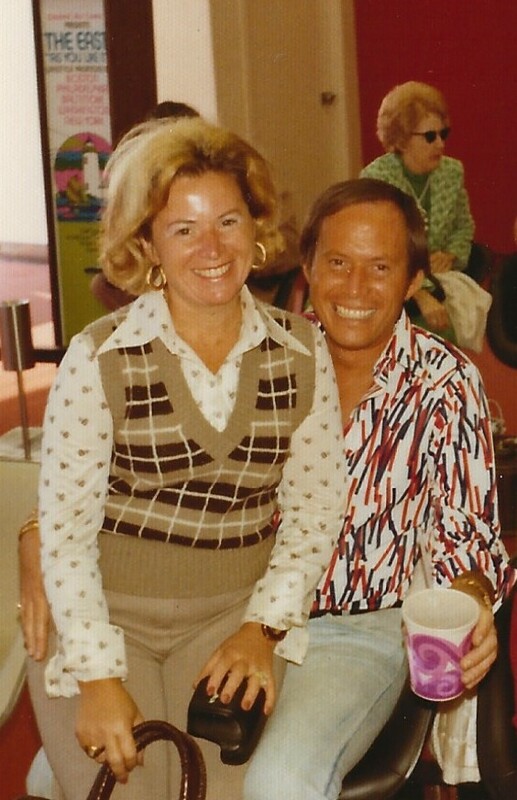
Bill Kovinsky
In 1982, William Kovinsky, known fondly as Billy, became the first reported Canadian to die from AIDS. His name was initially kept private, but after years of research by Walter Cassidy through obituaries, medical reports, and documents that he was able to piece together Billy's story. One invaluable source for Cassidy's research was Billy's sister Anna (pictured here) who, encouraged by her daughter, helped shed light on this crucial moment in the history of AIDS in Canada. Billy will be remembered not only for his role in this moment in history, but also for his warm personality, honesty, intelligence, and enthusiasm.
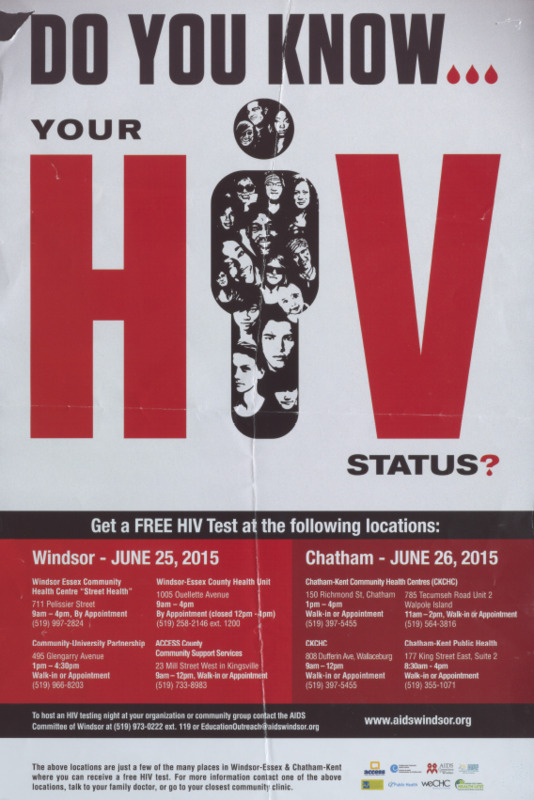
WRH HIV Anonymous Testing
In 1991, Windsor became one of the first municipalities in Ontario to offer anonymous AIDS testing. Before this, many people from Windsor crossed the border to Michigan, where anonymous testing had been available for years. This shift in Windsor marked a significant step toward accessible and confidential medical support in the region.
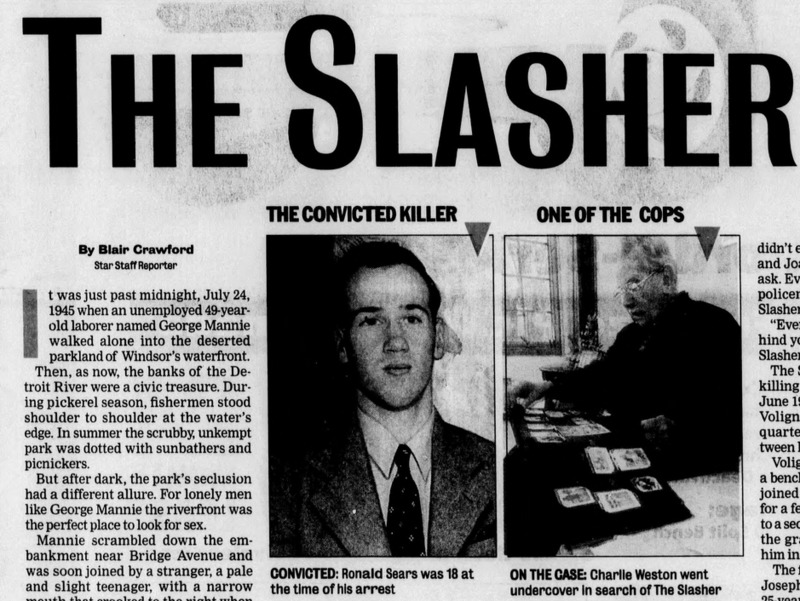
The Slasher
The “Windsor Slasher” was a serial killer who targeted queer men in Windsor between 1945 and 1946. His attacks led to the creation of the Windsor Police Auxiliary Service. Despite these killings, the city didn’t view the queer men as victims. Instead, the focus was on punishing queer people, with the creation of a "War Against Sex Crimes" campaign.

LGBTQ+ STEM Conference
In 2019, the University of Windsor hosted Canada's first LGBTQ+ in STEM conference, organized by Dr. James Gauld and Dr. Tricia Carmichael. The event brought together members of the LGBTQ+ community and allies to discuss research and share experiences in STEM. The conference has since continued to grow, with the goals of creating a more inclusive STEM community.
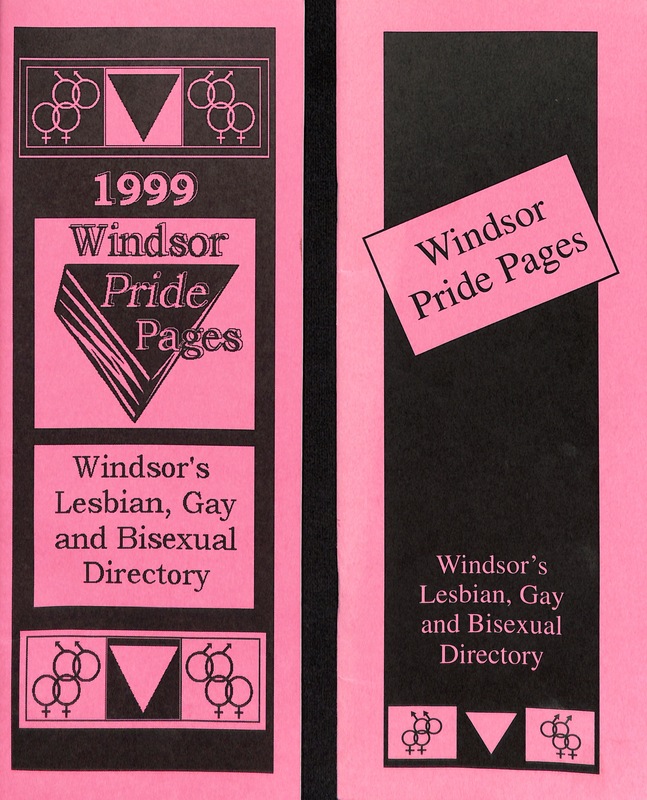
Pride Pages
The Pride Pages were directories published as a subset of Outspoken, a local queer newsletter. These pages included advertisements for queer-friendly spaces, information about community organizations and support, health and safety resources in response to the AIDS epidemic, and other updates about queer activism in the city. This form of communication was extremely important in building a community and sharing vital information.
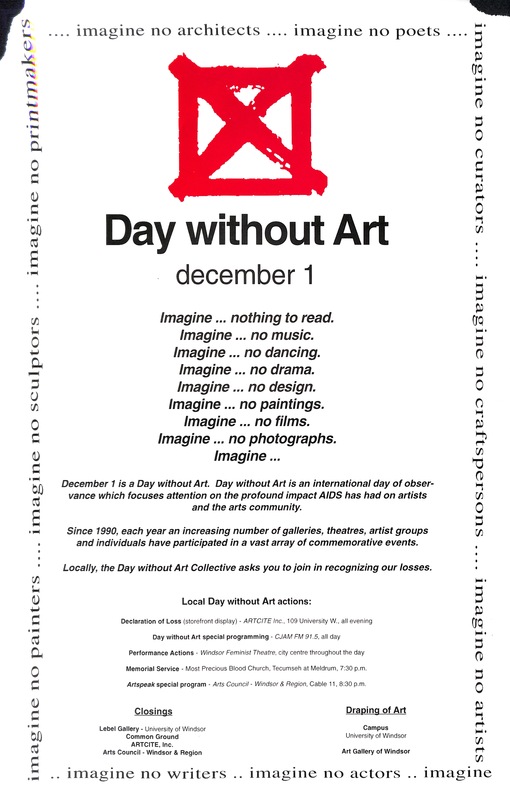
Day Without Art
The Day Without Art started in New York in 1989 as a way to raise awareness about the AIDS crisis. Typically, works of art were covered to demonstrate the sheer impact of AIDS, especially on the arts community and queer artists. In 1990, Windsor also began to participate. The first exhibit was held in MacKenzie Hall, where various posters were displayed and covered with dark cloth. Since then, this day of awareness has continued to grow, with many organizations and groups within Windsor participating.
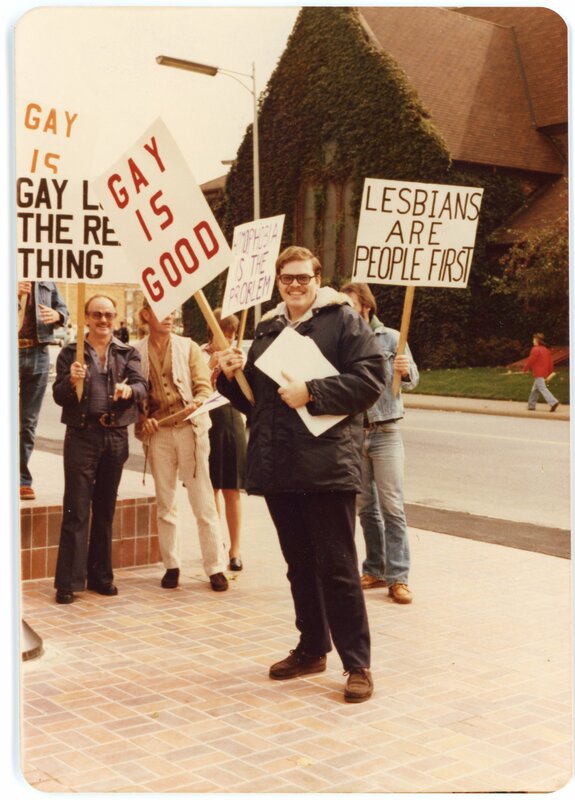
Harold Desmarais
Harold Desmarais was a prominent gay activist in Windsor at the forefront of much of the early queer activism in this region. He was one of the founders of the Windsor Gay Unity, as well as Gay Students on Campus at the University of Windsor. Harold eventually moved out of Windsor and joined the Coalition of Gay Rights Ontario. Although Harold’s journey started in Windsor, he soon became a notable leader for gay activism in Canada.
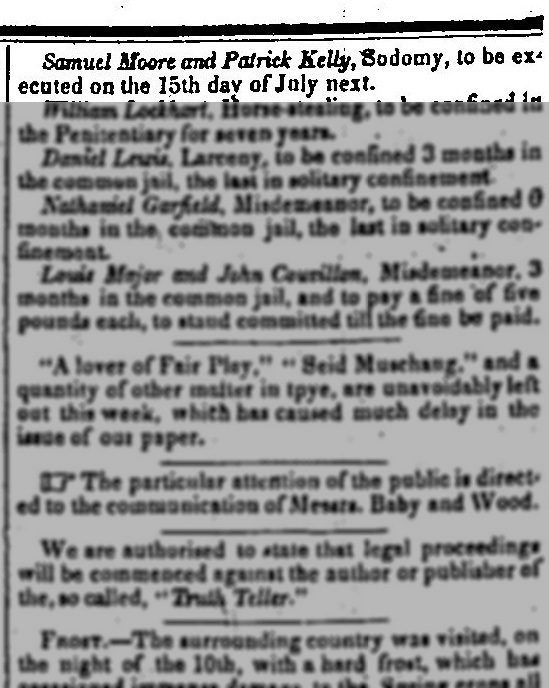
Canada’s First Men Convicted of Sodomy
In 1842, two soldiers stationed at Fort Malden, Amherstburg, Ontario, Samuel Moore (Service number 786) and Patrick Kelly (Service number 463), were the first two Canadian men who were convicted of engaging in sodomy. At the time, it was reported in the June 16, 1842, edition of the Western Herald, a prominent newspaper in the Windsor-Essex region at the time. Initially, both men pleaded not guilty, but were sentenced to death. However, both had their sentence commuted to life in prison.

Black, Queer and Here: 2SLGBTQIA+ Visibility in the Black Community in Essex County and Detroit
Black, Queer and Here was an exhibit at the Amherstburg Freedom Museum from June to August 2023. It was curated by Walter Cassidy, with support from Dr. Amorie Robinson, curator Mary-Katherine Whelan, and assistant curator, Dr. Lorene Bridgen-Lennie. This exhibit was an important starting point and reminder of the diverse voices and stories that are often overlooked in queer history.
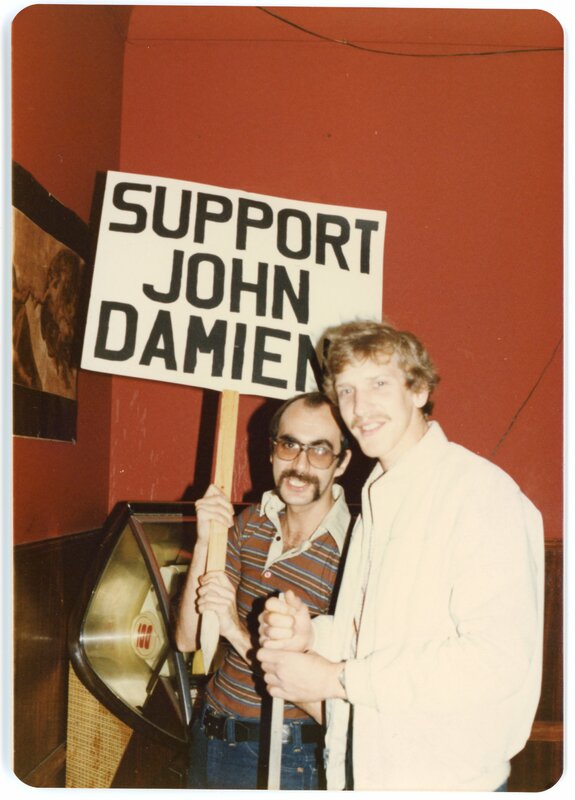
Jim Davies
Jim Davies was a queer activist in the Windsor-Essex region, who spearheaded advocacy for queer individuals in this region. Some of his most notable contributions included running a phone line for the queer community out of his apartment, being a founding member of the Windsor Gay Unity, and holding protests & spreading awareness in response to discriminatory cases.
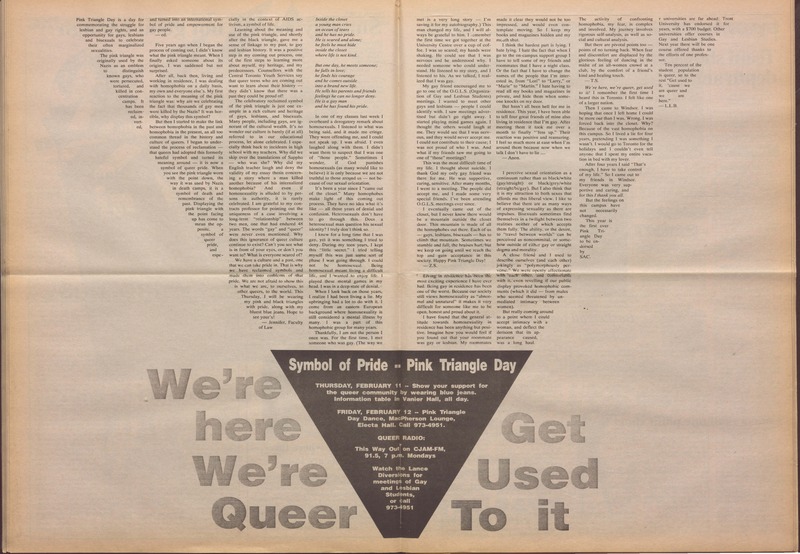
University of Windsor Pink Triangle Day
The Pink Triangle originated as a symbol in Nazi Germany, used to identify LGBT+ individuals during WWII. Over time, the queer community reclaimed this symbol as their own, as a show of resilience and inclusion in the face of discrimination. Pink Triangle Day was started by the Canadian Lesbian & Gay Rights Coalition and is held annually on February 14th to remember and celebrate the queer community. The first Pink Triangle day at the University of Windsor was held in 1993, and was featured in the February 8, 1993 edition of The Lance, the student newspaper.

Windsor's First Pride Day
On July 12, 1992, Windsor hosted its first official Pride parade. Unlike the usual June Pride celebrations, the event was held in July to avoid clashes with Pride celebrations in Toronto and Detroit. The theme of the event was “Get Used To It,” and it was an extremely successful event. Over 350 people came together to celebrate outside J.B.’s Restaurant and Bar, where the event was hosted. The event featured a variety of performances and activities, including acts by London drag queen Emerald Lady, body painting by Gary Menard, and a Miss Pride Day competition.
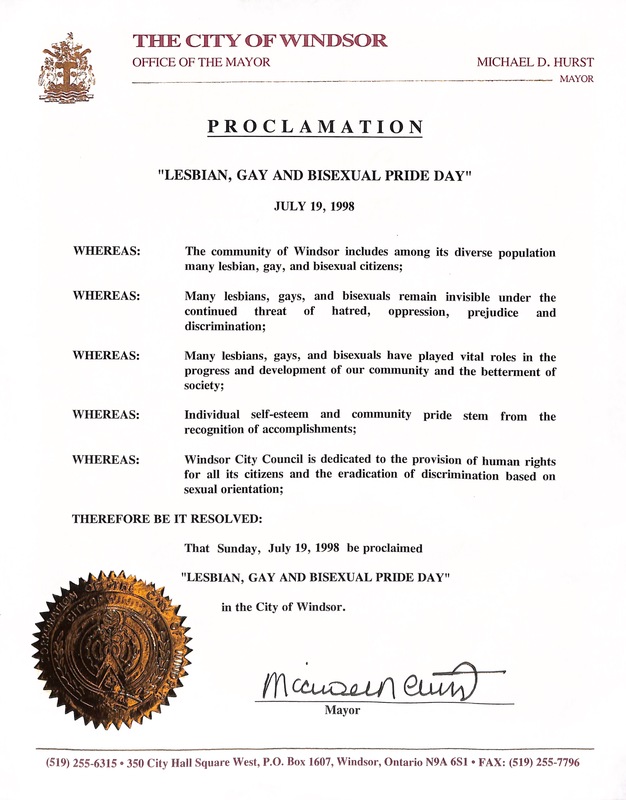
City Proclamation for the Annual Lesbian and Gay Pride Day
In 1992, the City of Windsor made its first official proclamation for the Lesbian and Gay Pride Day, becoming the fourth city in Ontario to officially proclaim a Lesbian, Gay, Bisexual and Transgender Pride Day. This milestone came after many years of activism to gain the support of the city for queer events. While the proclamation faced some backlash from the community, the city continues to issue annual proclamations in celebration of Pride Day.
Windsor’s First AIDS Walk
The AIDS Walk in Windsor began in 1991, initially raising $13,000 for the AIDS Committee of Windsor. It served as a way for the community to come together in support of those living with the disease and to honor those who had passed away. The walk not only honored those affected by AIDS, but also demonstrated a shift in how people viewed the disease. Instead of being seen as a punishment for ‘immoral acts’ towards the queer community, AIDS was recognized as a serious health crisis that required support from all members of the community and could impact anyone, regardless of their sexuality.

Windsor Gay Unity
Windsor Gay Unity (WGU), initally named Windsor Homophile Association, was a support group founded in 1972 to help connect and empower queer people in Windsor. Recognizing the lack of safe spaces for LGBTQ+ individuals, this group started to host social events, including dances at the University of Windsor.[1] WGU grew throughout the 1970s and was able to reach a wider audience by placing ads in The Body Politic, a national queer magazine, and establishing a phone line and P.O. Box to encourage people to reach out with any questions or concerns.[2] They continued to stand up for queer rights and advocate against discrimination, including organizing a fundraising campaign in 1975 to support John Damien, a local man who was fired from his job because of his sexuality.[3]
1. Bruce Blackadar, “‘I don’t try to hide what I am’,” Windsor Star, July 25, 1973.
2. “Windsor Gay Unity,” Windsor Star, August 19, 1978.
3. “NGRC raises over $6,000 for Damien,” Body Politic, February 1975.
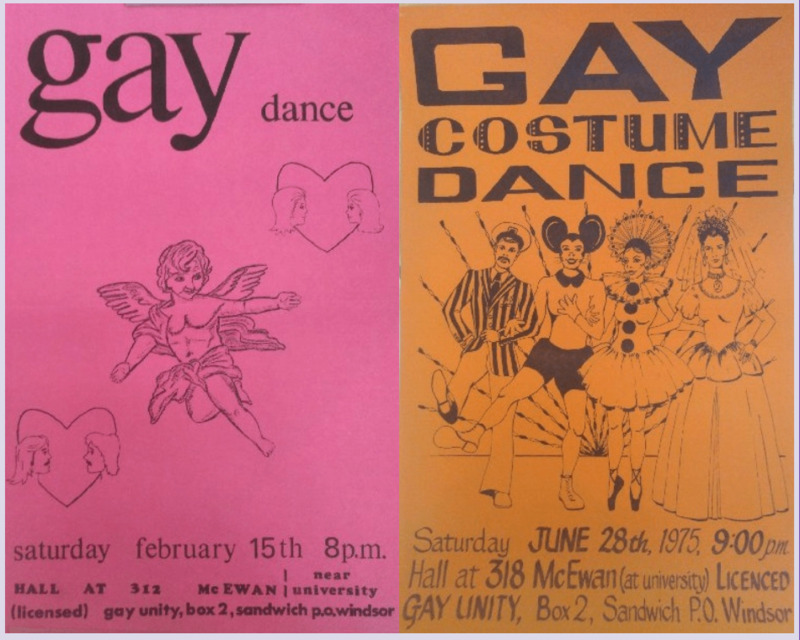
The Star Discriminates Against Gay Advertisement
On July 18, 1973, the Windsor Star refused to accept an advertisement sent in by Windsor Gay Unity (WGU) for one of their dances.[1] The ad that was submitted read “Gay Dance, Saturday 8 p.m., Alumni Lounge, University of Windsor.”[2] The Windsor Press Council, a regulatory organization for complaints against the paper, ruled in favour of WGU, stating that the Windsor Star “unfairly discriminated” against the organization by refusing to publish an advertisement for a social event.[3] Despite this setback, WGU found alternative ways to promote their events, including advertising through the university’s paper, The Lance.[4]
Sources:
1. “Press council rules against The Star,” Windsor Star, September 27, 1973.
2. “Press council.”
3. “Press council.”
4. “Windsor Paper Discriminates,” Body Politic, 1973.

John Damien
John Damien, originally from Windsor, was fired from his job as a Racing Steward in Toronto in 1975 after the Racing Commission discovered his homosexuality.[8] They claimed he could be blackmailed, despite him being open about it. At the time, there were no protections for gay people under the Ontario Human Rights Code, so his dismissal was legal. He was not allowed to defend himself before the Board of the Commission, and instead of accepting the settlement, he chose to publicly fight for his rights.[9] Damien fought publicly for the respect and rights of gay people. His case gained national attention and was one of the first cases about gay rights to get this level of coverage.[10] His work contributed to the eventual enactment of Bill 7 in 1986, which added sexual orientation to the Ontario Human Rights Code. He passed away six days after this bill was enacted, but left a lasting impact on the fight for gay rights in Canada.[11]
Sources:
8. Ken Popert, “John Damien: Spunky racing steward who defied discrimination succumbs to cancer,” Body Politic, February 1987.
9. “I’m Determined to Win,” Body Politic, June 1975.
10. “Spunky racing steward succumbs to cancer.”
11. “Spunky racing steward succumbs to cancer.”
Etna’s Steam Bath - Canada’s First Gay Bathhouse Raid
Etna’s Steam Bath, located at 563 Brant Street, was a popular bathhouse in the Windsor region. In 1964, it became the location of the first gay bathhouse raid in Canada. Nine men from Canada and the US were arrested for their participation.[12] Joseph Cepaitis, the owner of the Etna’s Steam Bath, was charged with keeping a bawdy house, more commonly known today as a brothel.[13] When Cepaitis was released from jail, the name of the bath house was changed to Vesuvio, and it continued to be a staple in the queer community until its closure in 2009.
Sources:
12. “Court,” Windsor Star, May 6, 1964.
13. “New Plea; Gets Year: Steam Baths Proprietor,” Windsor Star, June 30, 1964.
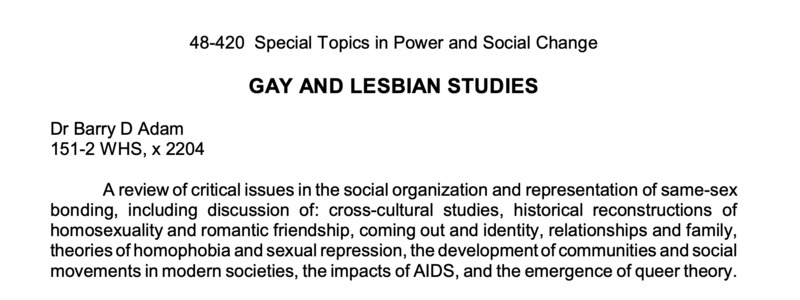
Gay and Lesbian Studies Course at University of Windsor
In January 1994, the University of Windsor offered its first course on gay and lesbian studies, titled “Special Topics in Power and Social Change: Gay and Lesbian Studies.”[14] This course was taught by Dr. Barry Adam, and it covered the history of homosexuality from the classical era to the present, exploring topics such as relationships, psychology, psychiatry, AIDS, homophobia, and identity.[15] Dr. Adam hoped that this new course would help queer students better understand their experiences and provide them with a safe space to learn about and discuss these critical topics.[16]
Sources:
14. Barry Adam. 1994. “48-420 - Special Topics in Power and Social Change: Gay and Lesbian Studies,” Syllabus, University of Windsor, Windsor.
15. Adam, “Gay and Lesbian Studies.”
16. Marsha Hull, “Gay, Lesbian Studies Added to Curriculum,” Neighbourhood News Magazine, November 17, 1993.
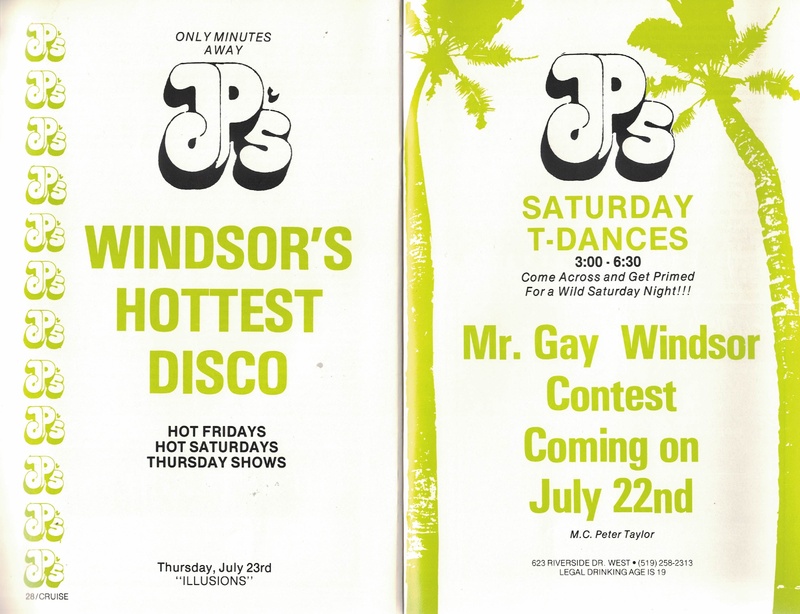
Local Bars
In the 1980s, gay bars in Windsor started being openly advertised, marking a shift toward increased visibility for LGBTQ+ spaces. Two prominent gay bars during this time were JPs and Louie’s. Louie’s advertised itself as “Ontario’s Largest Gay Showbar,” and emphasized its location just 3 minutes away from the Windsor-Detroit tunnel to attract more customers.[17] It hosted performances by female impersonators, go-go dancers, and live bands. JPs was advertised as “Windsor’s Newest Gay Bar,” and quickly became a popular spot, holding many local activities and events for the queer community. [18]
Sources:
17. “Louie’s Ontario’s Largest Gay Showbar,” International Justice Monthly, June 1981.
18. “JP’s - Windsor’s Newest Gay Bar,” International Justice Monthly, March 1981.
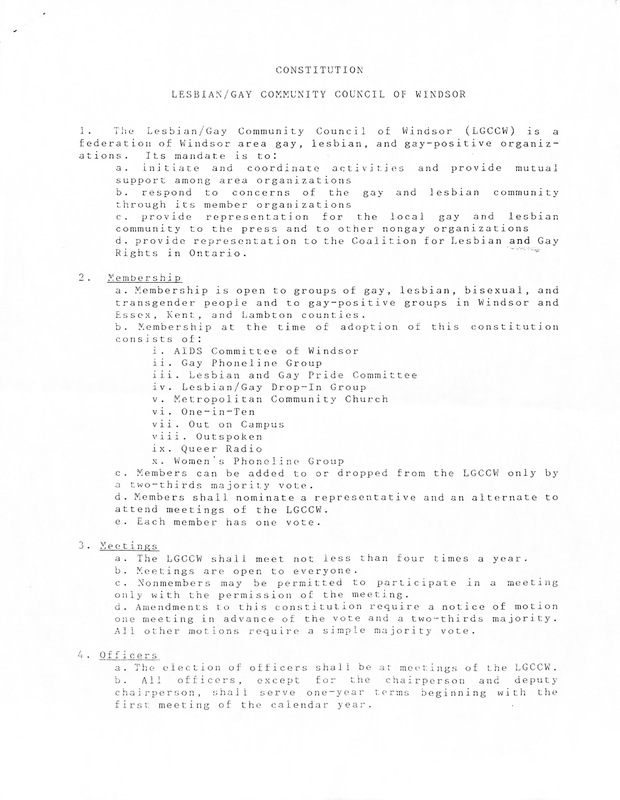
Lesbian/Gay Community Council of Windsor Constitution
In 1993, the Lesbian/Gay Community Council was founded, which replaced the Lesbian/Gay Community Service Group. The goal of this new organization was to bring together the various separate LGBTQ+ organizations in the area at the time. The founding members of this group included Dr. Barry Adam, John Danfour, Jim Monk, Kevin Bishop, and Beth Lyster, with Colin James serving as the first chairperson. The initial organizations that were brought together under the Council were the AIDS Committee of Windsor, Gay Phoneline Group, Lesbian and Gay Pride Committee, Lesbian/Gay Drop-In Group, Metropolitan Community Church, One-in-Ten Youth Group, Out on Campus, Queer Radio, and the Women's Phoneline Group. The official constitution of the Lesbian/Gay Community Council outlined information about its mandate, membership, meetings, officers, and dues.

One in Ten Support Group
In 1992, Kenn Stanton and Chris Cecile worked together to create the One in Ten Youth Group in Windsor, which was a support group for queer youth in the city.[19] The group was named after the statistic that 1 in 10 people are gay, reflecting the need for a dedicated space for queer youth.[20] This was a critical resource for the community, especially considering the lack of resources and support for queer youth and the alarming suicide rate among gay teens, which was significantly higher than that of heterosexual youth.[21] Within its first year, the group had already had 40 self-identified queer teens join, highlighting the need for this support in the community.[22]
Sources:
19. Gail Robertson, “Gay teens get a lifeline,” Windsor Star, October 1, 1992.
20. Robertson, “A Lifeline”.
21. David Lyons Jr., “High suicide rate for gay teenagers,” Windsor Star, October 12, 1993.
22. Lyons Jr., “High suicide rate for gay teenagers”.
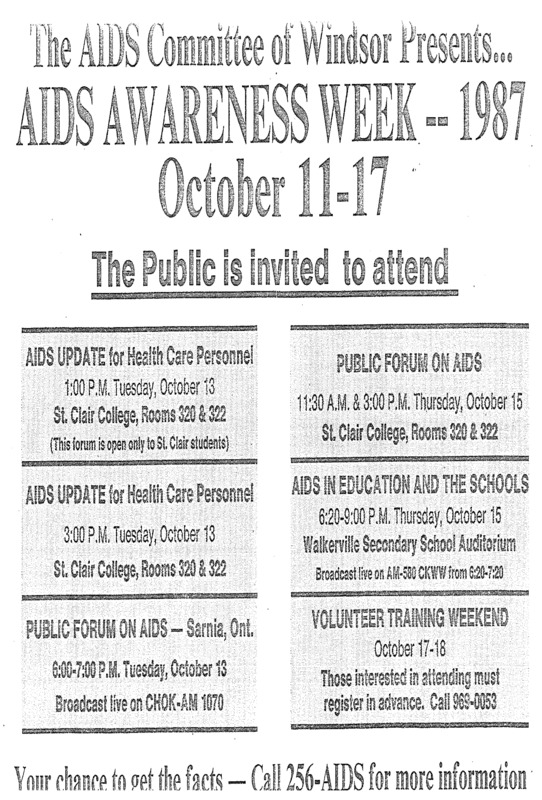
First AIDS Awareness Week Declared by the City of Windsor
In 1984, Windsor’s City Council rejected the idea of declaring an AIDS Awareness Week, arguing it would be inappropriate for children and could promote a lifestyle they believed contributed to the spread of the disease. However, on October 11-17, 1987, the city held its first AIDS Awareness Week, replacing the previous Gay Awareness Week in response to the growing need for education and support during the AIDS epidemic. The week's activities included workshops and public forums, including sessions at St. Clair College and Walkerville High School. By 1995, AIDS Awareness Week had become a nationally recognized event, gaining more community support, including a red ribbon display at Massey Secondary School to raise awareness about the disease.[24]
Sources:
24. “Ribbon of Hope,” Windsor Star, September 26, 1996.
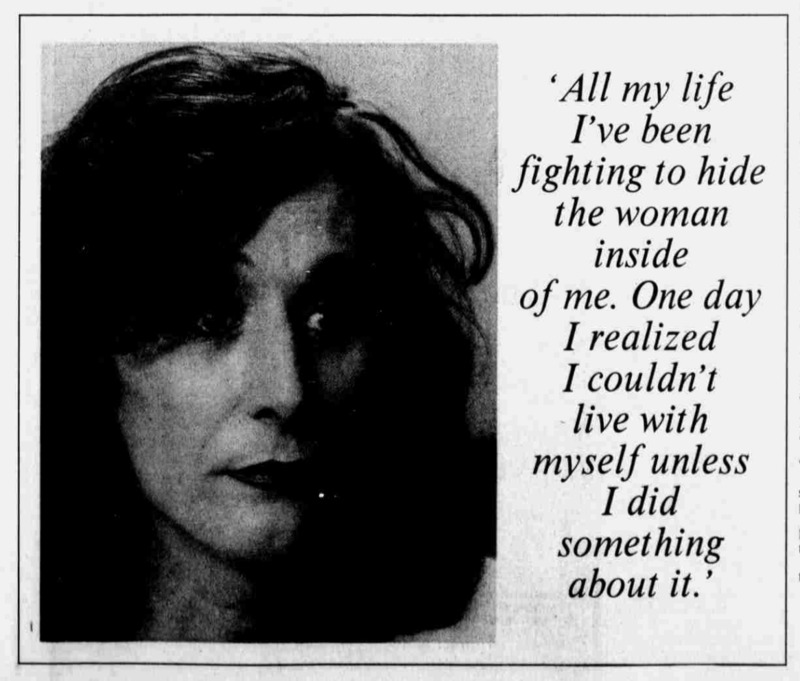
Sarah Carrol
Sarah Carrol was a transgender woman who was elected to a local riding association with the Reform Party of Canada in 1992.[25] She worked to raise awareness and fight for the rights of transgender individuals.[26] However, her efforts were met with intolerance from the Windsor community.[27] Despite sharing her personal journey in the Windsor Star to educate others, including intimate details about her family and medical treatments, she faced threats and was forced to leave the city.[28; 29] In 1997, Carrol passed away from AIDS in Vancouver.[30] Tragically, her obituary was published by the Windsor Star using her deadname, reflecting the ongoing transphobia in the community. This treatment from Windsorites, both during her life and after her death, highlights the challenges transgender individuals faced at the time and continue to face today.
Sources:
25. Blair Crawford, “Plea for tolerance silenced by AIDS,” Windsor Star, May 15, 1997.
26. “People and attitudes,” Windsor Star, January 25, 1992.
27. “People and attitudes”.
28. Susanne Craig, “SHE: ‘I’ve always known I should be a woman’,” Windsor Star, February 6, 1992.
29. Crawford, “Silenced by AIDS”.
30. Crawford, “Silenced by AIDS”.
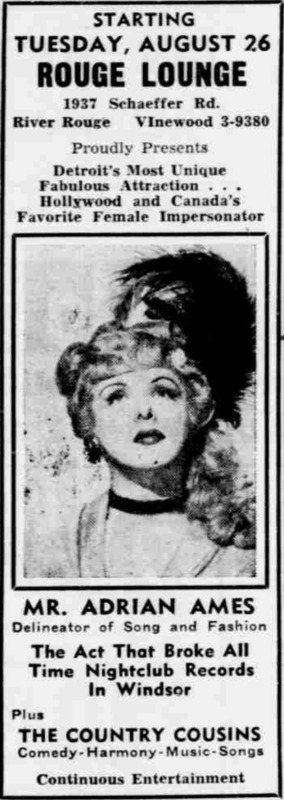
Adrian Ames
Adrian Ames was a popular female impersonator, known for her performances in Windsor and Detroit during the 1950s. In 1952, she performed at White’s Elbow Room in Windsor, where she was advertised as “the greatest female impersonator since Julian Eltinge” and “Windsor and Detroit’s Most Glamorous and Fabulous Star.”[1] [2] Ames was also famous for her collection of dresses, including pieces worn by major stars like Rita Hayworth.[3] After her eight-week engagement at the Elbow Room, she continued to perform at the Rouge Lounge, where she was advertised as “The Act That Broke All Time Nightclub Records in Windsor.”[4] Ames went on to tour and perform across North America. For more information about female impersonation in Windsor and Detroit, read Nicholas Hrynyk's piece in the Essays section of this site.
Sources:
1. “The New Eltinge,” Windsor Daily Star, August 2, 1952.
2. “White's Elbow Room Presents Nightly Mr. Adrian Ames,” Windsor Daily Star, July 28, 1952.
3. “The New Eltinge."
4. “Mr. Adrian Ames Delineator of Song and Fashion,” Windsor Daily Star, August 25, 1952.